The White Rims at Pamukkale
The shallow pools below Hierapolis can be read from the rim outward: a thermal spring supplies the water, and the water gradually sets down new rock.
In this story 5 sections
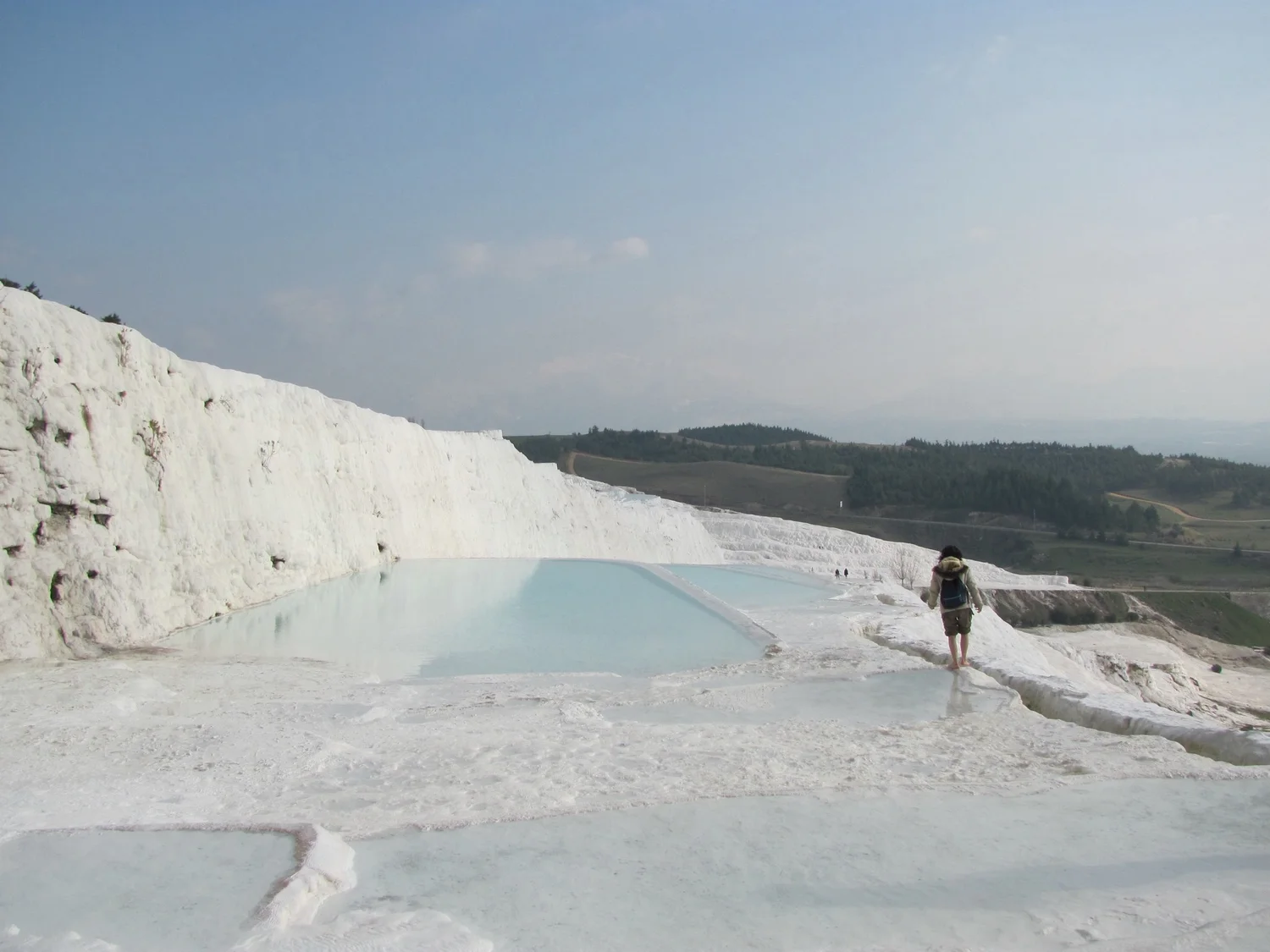
The thin white rim in a photograph of Pamukkale can be hard to place. A blue pool appears to stop at it. Immediately below, long white ridges turn into another pool, or a series of much smaller ones. Seen from farther away, they look like scraps of shoreline laid one above the other. You could mistake them for the result of an excavation from which the softer ground has been carried away. In an active patch of Pamukkale, though, the edges can also grow. Water supplies the material that makes the next layer of their borders.
Pamukkale sits in southwestern Türkiye, near Denizli. Its name is often translated as cotton castle, and there are views in which the comparison is easy to understand. Ridges that would look angular if exposed as gray rock fade into one another in the bright white expanse. The color photograph records the blue of the sky or water and the tortuous boundaries between pools, but those boundaries also record the paths of springs. For a closer picture of what happens here, begin with a single crossing from one pool to the next.
The stone was in solution
When we say that the spring delivers rock, imagine the delivery at a scale smaller than sand. Water that moves underground can contain dissolved material. In this region, carbonate chemistry and carbon dioxide matter to the appearance of the water after it reaches the surface. When the conditions change, mineral can precipitate from the solution. Calcium carbonate building up at a spring over time can form a kind of limestone called travertine. A smooth white lip is one possible shape of that deposit.
An everyday comparison is the scale inside a kettle. There, too, dissolved material can eventually leave behind a hard deposit. The kettle differs in its heat, geometry and source of water. It would not make a miniature version of Pamukkale in any useful scientific sense. The analogy helps with a simpler point: completely ordinary looking water can leave a solid deposit with no delivery of visible grains. Check the old dry line on a vessel that holds hard water. The stuff below the line was largely in the water without being visible until the liquid was gone.
At a thermal spring, water enters a different setting when it breaks the surface and flows into open air. Conditions can favor loss of some dissolved carbon dioxide. The equilibria governing dissolved carbon species shift with that change, which can favor the precipitation of calcium carbonate when the other conditions are right. The comparison with kettle scale should not lead you to think that the springs have to boil. Bubble formation, changes in the amount of gas, water movement and contact with surfaces all give the water opportunities to change before it has traveled very far.
A little wall diverts its own material
Look at the pool rim running across the middle of an image. If water entering the pool flows over that rim, it reaches a free edge. The sheet of water can thin, break into different threads or pass along ridges already present. Deposition can proceed differently there from the way it does under the quieter water behind the lip. The change is one reason a pool’s shape can direct future mineral growth. Raising the lip or filling part of a floor then alters the depth or direction of the next flow.
Now imagine one low point in that lip. Water needs less depth upstream to spill there than at the other end of the pool. That low point could remain the active path for a time, even if other edges stay white in the photograph. If material builds up in its path, another exit might eventually become more important. What you see now is one arrangement of level, supply and flow sitting on top of material left by earlier arrangements. You cannot confidently predict the next spillway from the beauty of the current one.
Fine details matter to that conclusion. There is a difference between a thin veil of water moving down the front of a rim and a broad canal coming into the pool behind it. There can be dry ridges beside active seepage. Look for little places where a surface shine begins and ends. Reflected blue light from above can make a shallow wet area seem like a deep bowl. It is often easier to trace several adjacent pools with a pencil than to judge depth from color alone.
A snapshot leaves out the supply
It would be tempting to classify pale surfaces as active and dark ones as abandoned. Whiteness is an appealing shorthand from across a valley, but it does not give you an unambiguous record of when a given spot received water. A wet surface can look darker than the same material when it dries, depending on how light reaches it. Other material that accumulates at a surface can change the color, too. A screen may make whiteness look exceptionally uniform because the brightest areas lose detail in the image. Where the distinction matters, use repeat observations and information about the water rather than interpreting every change as a change in the rock.
A conservation study at Pamukkale investigates the thermal water and the condition of the travertines together. That belongs to the practical history of a landscape formed by flows: water made available at one place can be water that does not reach another. A path a few meters long can deliver it to a useful set of pools, or leave a different set dry. Managing the water can therefore affect what the land looks like while preserving aspects of the process that built the land. Understanding that work requires more than judging whether a line of pools looked beautiful in one visitor’s view.
A thought experiment puts the difficulty on a scale that is easy to see. Consider a model made of three shallow dishes on sloping ground. Arrange that one receives the full supply and then overflows into the second and third in turn. Now divert the incoming water slightly sideways. The third dish may still have everything it once held, but when the water in it is gone no replacement crosses the original rim. A maintained pool and a temporary puddle can look remarkably alike for a little while. Looking later tells you something a first visit could not.
The city belongs to the same landscape
Above the white slope are the remains of Hierapolis, whose theater, graves and other structures have an architectural history different from the history of the springs even though they share the same site. UNESCO describes the property in terms of both the built place and the springs and travertine terrain. Someone concentrating on the ruins can spend considerable time reading the shape of passages, seating and stone walls. The plain below is still in the picture. The location that gave the place thermal water also gave visitors and inhabitants a great slope to look across.
This is one reason to keep a wide image as well as a close one. In a close picture an irregular surface can appear to be pure scenery. A wider view shows what is uphill, where adjacent ground meets the rim and what other paths are available alongside the surfaces made by water. An even wider map can make sense of the position of Hierapolis and the towns below. Each view loses something. Put the images next to one another rather than expecting a single crop to represent all three scales.
If you compare an old view with a new one, identify a solid feature common to both, rather than lining up the blue in the pools. A large piece of built stone or a prominent end of a slope may let you approximate the photographer’s position. Apparent changes in the water will be easier to discuss once you rule out a frame several meters to one side. If the landmark itself is built, bear in mind that reconstruction and maintenance may also affect your comparison. The value of a paired observation comes from being able to say what stayed measurable as well as what appeared different.
Give the water back its time
A photograph brings every rim into the same instant. Wet terraces lower down seem to serve as a setting for whiter or drier ones above. There is nothing in that one instant to tell you how many mornings it took for a rim to acquire its shape. Geologists studying deposits have to look at material and setting, and can ask how the conditions at which it formed vary from one place to the next. They also have to choose whether they are studying where rock is forming now or how a much larger mass of old material came to occupy this slope. Very different amounts of time are embedded in those questions.
Go back to the smallest rim in the photograph. If you can see a thin water line behind it and a bright ledge on the far side, separate their roles in your mind. At the moment the water is held by the stone. On the longer timescale the next bit of stone depends on what the water does. From above, they make a pair of adjacent colors. At the edge itself they amount to a path with a memory: each crossing can change the ground on which a later crossing will happen.