The Stripes on the Bungle Bungles
The dark bands on Western Australia’s sandstone domes sit on rocks whose layers hold moisture differently. Their appearance records both the shape of the rock and the conditions at its surface.
In this story 5 sections
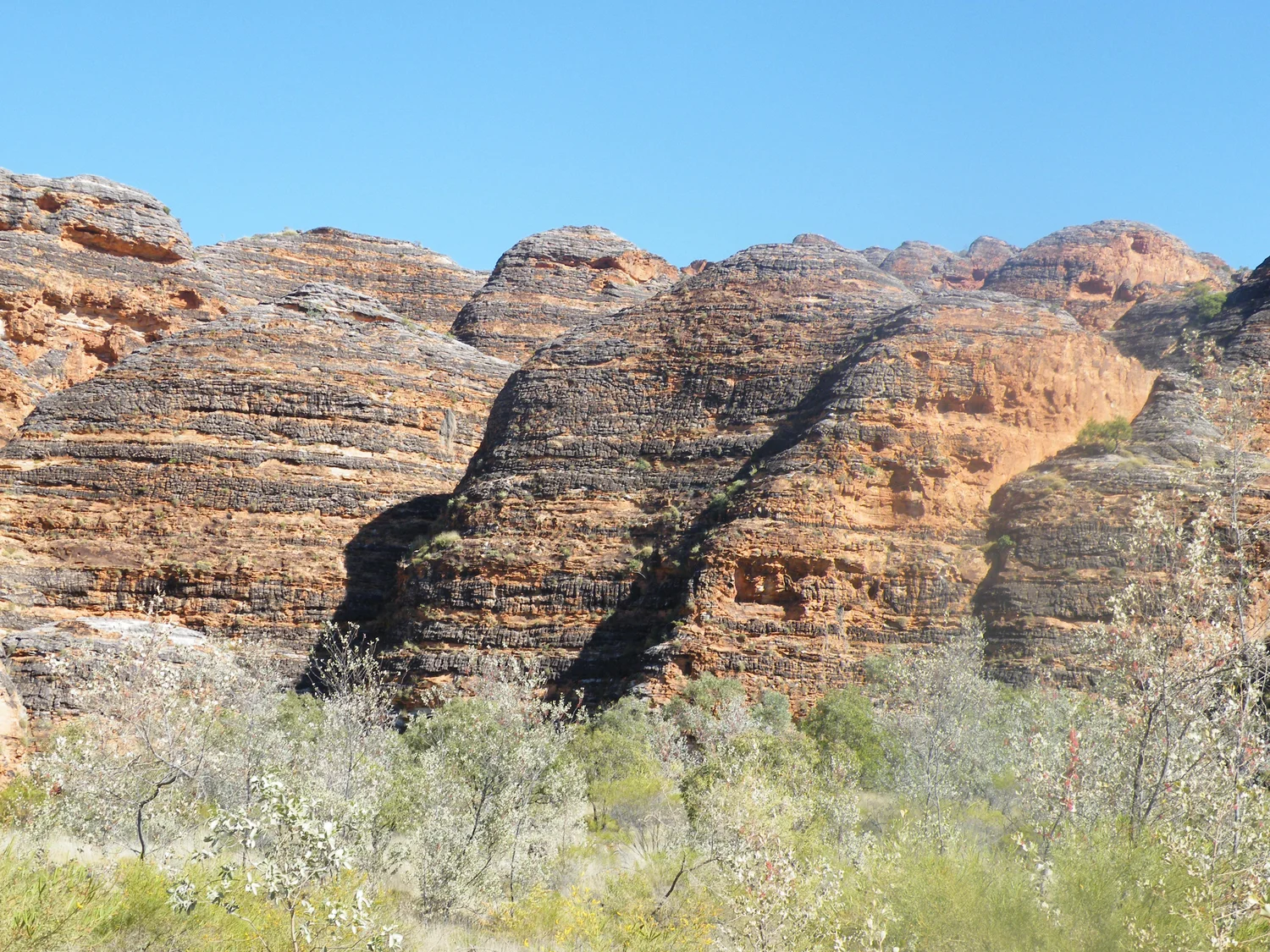
In BriMiDra’s photograph the domes at Purnululu carry deep shadows near their feet. Look higher and some of the dark marks clearly belong to something other than the angle of the sun. Bands continue across folds of rock and alternate with warmer orange levels. The top edge of one dome is rounded and the next appears past it at a different height. Both keep a kind of horizontal tally on their visible sides. It looks a little like a stack uncovered by someone taking away material from around it. At the same time, the dark surfaces need a story that begins well after the layers were laid down.
The Bungle Bungle Range is in Purnululu National Park in Western Australia’s East Kimberley. The park authorities identify the Jaru, Gija and Malngin peoples in their account of native title and the long history of people in the landscape. A photograph of a few towers is a small selection from that much larger place. Geologically the curved shapes are notable because sandstone beds are exposed in such a way that the conditions on different layers can be read at a distance. There are at least three steps to follow: how the layered rock acquired its differences, how some parts remained as steep domes, and what continued to happen at their exposed faces.
A dome and a bed describe different shapes
A bed of sandstone is a layer of sediment that was deposited and became rock. One bed can occupy a broad area before erosion separates portions of it into exposed shapes. Look at a dome from the side and a band can cut across its outer profile. Follow the band and it may meet shade, a break or another exposed side. The contour of the dome is related to the material the outside has lost; the band relates to a layer surviving in the part left behind. The two lines need not keep the same direction. One goes around the visible outer shape and one follows a level through it.
Weathering and erosion act along available surfaces and fractures. From a distance it can seem as if somebody carved a pile of complete, free-standing forms in one action. A better first study is to look for the spaces between the domes and the lines of weakness that could have helped water and other physical processes cut into the rock. The material still left can record its layers after the surfaces between them became more exposed. The process by which the domes were defined is older and longer than the patches of light and shade visible on any visit.
A cliff and a rounded tower can expose similar bedded material and still present it very differently. In the tower, a person can move around to see a new arc of the same shape; a part hidden by one foreground bulge can become conspicuous from another angle. That movement can help tell whether a dark strip is likely to follow a bed or comes from a nearby surface blocking the light. A photograph can show repeated bands clearly where there is even illumination. It remains useful to compare the darker marks on a side in shade with the ones that remain distinct in full light.
Different layers can stay damp for different lengths of time
Western Australia's parks account connects dark bands with cyanobacteria on parts of the sandstone where moisture collects or persists. Other exposed layers dry out sooner and do not offer the same conditions for that darker surface growth. The orange bands show a different appearance of the rock. This is why a sequence of stripes offers more information than a simple choice between layers made of black sand and layers made of orange sand. A part of the color difference developed at the surface, but conditions at the surface reflect underlying differences in the bedded rock.
Imagine water reaching two adjacent portions of a weathered face. One could lose it quickly while the other retains enough at the surface to remain damp longer. The amount that falls onto the face is not the only thing that matters. What the stone does with the water changes what can happen after the shower or flow has ended. Repetition over many episodes can matter more to a persistent surface pattern than any one wet or dry afternoon. A photo showing entirely dry air over the domes does not rule out the evidence of the wetter conditions described by the park.
There is a useful contrast between wet ground and a dark coating. A surface can change colour briefly as it gets wet and dry again. A persistent dark band is not always a record of a recent event just because it appears dark. The park's account explains why some recurring bands can be related to the conditions in which organisms on the surface grow. Some other differences in shade are still likely to come from ordinary lighting. It takes observations of the rock and the features following its bedding to tell one sort of evidence from the other.
Moisture also follows the spaces around the rock
A curved formation creates its own possibilities for where water can gather or drain. A broad face receives weather differently from a recess or a joint. Larger shapes also collect or divert water in the spaces between their slopes. A narrow hollow might direct a flow along its floor. A bare exposed face can receive it briefly on the way down without holding it long. In the broad view of a single band there may be parts with quite different exposure even at the same level. That is a reason to think of the overall stripe and its finer irregular edges as related evidence, rather than expecting every metre of it to look identical.
A local comparison of two surfaces can be made without claiming everything about the weather in the region. A person looking from near a gully might see staining or a sharp boundary following part of it. A higher view can reveal bands extending along surfaces unrelated to that one gully. Set those views beside bedrock descriptions and one can ask which marks repeat because of layers and which are more closely associated with a local contact or exposure. The more useful conclusion may be different for adjacent pieces of the same picture.
UNESCO's account explains that the dark surface growth is part of the notable appearance and can help protect the rock. That offers another reason to distinguish the colour of a surface from the appearance of material freshly exposed behind it. A surface layer can be thin in comparison with the body of the dome and still matter to the eye and the rock it covers. The photograph is unusually good at showing how a small material feature can be repeated across a large geological form.
Two distances from the same stripe
At a distance the tones draw the eye sideways across the profiles. Get close enough in a reproduction and variations in colour and texture come forward. The nearest visible shrubs suggest one scale. The dome with its outlined summit suggests another. It can be difficult to keep those scales distinct in a photograph that compresses distances. Reading the bands partly as a series of surfaces near the eye and partly as lines across a large body of rock helps explain their striking appearance without assigning every visible line to the same cause.
It also helps to take the photograph as a small part of Purnululu. A rounded outcrop, land between two towers and a deeper gorge need not offer the same impression, even where they reveal parts of the same geological setting. The vegetation visible at ground level is another reminder that the view is more than a silhouette of domes. What the image does well is let a reader ask about the relation of layers, water and the exposed faces at an ordinary distance from all of them.
Another image of the same domes later in the day might change the brightness of both bands without changing their positions. Comparison is strongest when it follows the edges that remain associated with the same rock. That is why documenting the position and direction of a view can matter as much as keeping its colours. A periodic band that persists while a neighbouring shadow moves is evidence of a different sort from the dark sweep at the foot of an outcrop.
Follow the band around the turn
Choose one darker band high enough to stay out of much of the nearby shadow. Follow it until a bulge takes it out of sight. Notice how it traverses a rounded surface without turning into the outer boundary of that part of the dome. The line is evidence of a material setting a person can see at a distance. The conditions that caused it to appear are partly about the way water has behaved against those particular layers at many different moments.
The domes make the conditions of a surface part of the way an entire landscape can be recognized. Without the underlying rock, the bands would not have their recurring positions. Without later exposure and different responses to water, the layers would not all offer the same dark and bright contrast the photo shows. The view holds those processes together without allowing the newest shadow or the most conspicuous stripe to stand for the whole history of the place.